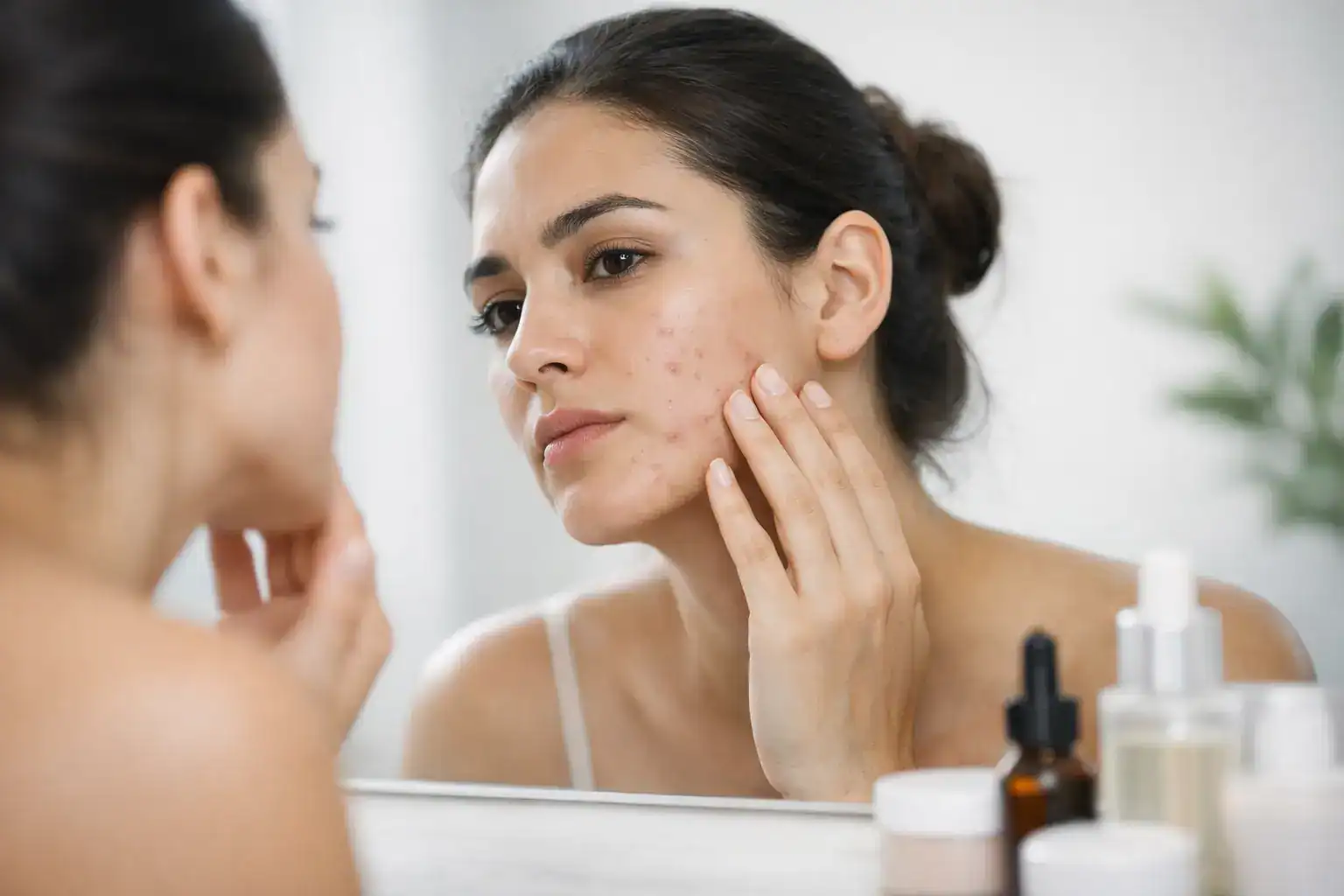
Deep acne scars can be among the most difficult forms of acne scarring to improve because the damage often extends below the skin’s surface. Unlike mild discoloration or shallow textural changes, deep acne scars may involve collagen loss, fibrous attachments beneath the skin, sharply defined depressions, or narrow scars extending into deeper layers.
For this reason, the best acne scar treatment for deep scars is rarely a single procedure for everyone. We achieve better treatment planning when we first identify whether the scars are ice-pick scars, rolling scars, deep boxcar scars, or a combination of several types.
Dermatologists frequently combine procedures because different treatments address different structural components of acne scarring. The American Academy of Dermatology notes that depressed acne scars may be treated with procedures, scar surgery, fillers, laser treatment, microneedling, radiofrequency, chemical peels, or combinations of these approaches.
What Makes an Acne Scar a Deep Scar?
Deep acne scars usually develop after significant inflammation damages collagen within the skin. During healing, the body may not replace enough collagen, leaving an indentation.
The appearance and depth of the scar determine which treatment is most suitable.
Common Types of Deep Acne Scars
Before choosing treatment, we generally distinguish between three major types of depressed acne scars:
- Ice-pick scars: Narrow, deep scars that resemble tiny punctures or enlarged pores.
- Boxcar scars: Round or oval depressions with clearly defined edges. They can be shallow or very deep.
- Rolling scars: Broad depressions that create an uneven or wave-like skin surface, often because fibrous bands pull the skin downward.
A person can have all three types simultaneously. This is one reason a treatment that works extremely well for one scar may produce limited improvement in another.
Best Treatments for Deep Acne Scars
When treating significant acne scarring, we focus on the physical structure of each scar rather than selecting a procedure simply because it is popular.
1. Subcision for Deep Rolling and Tethered Acne Scars
Subcision can be especially useful for rolling or tethered scars.
Some depressed scars remain pulled downward because fibrous bands beneath the skin attach the scar to deeper tissue. During subcision, a medical professional introduces a specialized needle or instrument beneath the scar to release those fibrous attachments.
Once released, the depressed skin can rise toward the surrounding surface.
DermNet describes subcision as a technique that divides the fibrous band beneath a targeted scar, allowing the skin to return toward its normal position. It can also be combined with treatments such as microneedling, TCA CROSS, chemical peels, and fractional laser treatment.
For deeper rolling scars, we may therefore consider subcision before resurfacing procedures because resurfacing alone may not fully correct a scar that is physically tethered underneath the skin.
2. TCA CROSS for Deep Ice-Pick Scars
For narrow, deep acne scars, TCA CROSS may be considered.
TCA CROSS stands for trichloroacetic acid chemical reconstruction of skin scars. Instead of applying acid across the entire face like a conventional chemical peel, a trained clinician places a small amount of concentrated TCA directly inside selected scars.
The resulting controlled injury stimulates remodeling and new collagen formation.
TCA CROSS is commonly used for atrophic scars, including ice-pick and boxcar scars, although complete removal of the scar should not be expected from one treatment alone.
Multiple sessions may be required, and professional application is important because incorrectly placed high-concentration TCA can cause burns, pigmentation changes, or additional scarring.
3. Punch Excision for Very Deep Acne Scars
Some scars are too deep and sharply defined to respond adequately to standard resurfacing.
In these situations, punch excision or another minor acne scar surgery may be considered.
The dermatologist removes the individual scar using a small surgical instrument and then closes the area so that it heals as a smaller, flatter scar. Other approaches may involve punch grafting depending on the scar.
DermNet notes that excisional techniques can be useful for prominent, deep, fibrotic, or hypopigmented scars.
After healing, additional resurfacing procedures may be recommended to improve overall texture and blend the treated areas with the surrounding skin.
4. Fractional Laser Resurfacing for Deep Acne Scars
Fractional laser treatment is another established option for improving depressed acne scars.
Laser resurfacing works by creating controlled treatment zones in the skin. The healing response encourages collagen and elastin production while gradually improving surface irregularities.
Different laser systems have different depths, downtime, benefits, and risks.
For significant scars, several sessions may be required. Dermatologists may also combine laser resurfacing with another procedure. For example, deep scars may first require subcision or surgical correction before laser treatment is used to improve the remaining texture. The American Academy of Dermatology specifically notes that treatment plans for deep acne scars can include laser treatment together with procedures such as fillers.
Laser selection becomes particularly important for people with darker skin tones because aggressive treatment can increase the risk of post-inflammatory hyperpigmentation or other pigment changes. Treatment should therefore be customized according to skin tone as well as scar type.
5. Microneedling for Atrophic Acne Scars
Microneedling, also called collagen induction therapy, creates controlled microscopic punctures within the skin.
These tiny injuries stimulate the natural wound-healing process and encourage new collagen production. Over a series of treatments, this can soften depressed scars and improve overall texture.
Microneedling may be helpful for widespread atrophic scarring and can be combined with other treatments.
The American Academy of Dermatology states that microneedling is used to diminish acne scars and is considered suitable for all skin tones. Results develop gradually as collagen remodeling occurs.
For very deep scars, however, microneedling alone may not address every structural problem. A narrow ice-pick scar, for example, may require targeted treatment, while a tethered rolling scar may require release with subcision.
6. Radiofrequency Microneedling for Deep Acne Scars
Radiofrequency microneedling combines traditional microneedling with controlled radiofrequency energy.
The needles create microscopic channels while delivering heat into deeper skin layers. This additional energy can stimulate collagen remodeling below the surface.
We may consider radiofrequency microneedling when the goal is to improve:
- Depressed acne scars
- Uneven skin texture
- Broad rolling scars
- Collagen loss
- Overall skin smoothness
The American Academy of Dermatology reports that both radiofrequency and radiofrequency microneedling can be used for acne scarring and are considered suitable for different skin tones.
As with other procedures, treatment depth and energy settings should be selected by an appropriately trained clinician.
7. Dermal Fillers for Depressed Acne Scars
Certain deep scars improve when volume is restored beneath them.
Dermal fillers can be injected under selected depressed scars to raise them closer to the level of surrounding skin. Fillers may be particularly useful for broader rolling scars or areas where acne has caused noticeable volume loss.
The effect depends on the type of filler used. Many fillers provide temporary improvement and require future maintenance treatments.
Fillers are also frequently combined with subcision. Once the fibrous bands pulling a scar downward have been released, filler can provide additional support underneath the treated area.
Which Acne Scar Treatment Works Best for Each Scar Type?
Choosing treatment becomes easier when we match the procedure to the scar’s structure.
| Acne Scar Type | Treatments Commonly Considered |
|---|---|
| Deep ice-pick scars | TCA CROSS, punch excision |
| Deep boxcar scars | Punch techniques, fractional resurfacing, TCA CROSS in selected scars |
| Rolling scars | Subcision, fillers, microneedling, radiofrequency microneedling |
| Tethered scars | Subcision, sometimes followed by fillers or resurfacing |
| Mixed deep scars | Combination treatment tailored to each scar |
This individualized strategy is important because deep acne scars are structurally different. Treating every scar with the same procedure can leave the most difficult scars inadequately corrected.
Why Combination Acne Scar Treatment Often Works Better
People with significant acne scarring frequently have more than one scar type.
For example, one person may have:
- Ice-pick scars on the cheeks
- Deep boxcar scars around the temples
- Rolling scars along the lower cheeks
- Dark marks left from previous acne
- Ongoing breakouts
No single procedure targets all of those concerns equally.
A dermatologist might therefore create a staged plan involving subcision for tethered scars, TCA CROSS for ice-pick scars, fractional resurfacing or microneedling for texture, and fillers for selected depressions.
The American Academy of Dermatology and DermNet both describe multimodal approaches in which more than one procedure is used to address different characteristics of acne scarring.
Deep Acne Scar Treatment for Darker Skin Tones
People with brown or deeply pigmented skin can successfully undergo acne scar treatment, but procedure selection requires careful attention.
Darker skin may be more prone to post-inflammatory hyperpigmentation, particularly following aggressive procedures or excessive inflammation.
We therefore look carefully at:
- Skin tone and pigmentation history
- Previous reactions to procedures
- Scar depth and type
- History of keloid formation
- Current acne activity
- Type and intensity of laser or energy treatment
- Sun exposure
- Pre-treatment and aftercare requirements
Microneedling and radiofrequency microneedling are among the procedures commonly considered across different skin tones.
Laser treatments can also be used in appropriately selected patients, but the laser type, settings, and practitioner experience matter significantly.
Treat Active Acne Before Treating Deep Scars
Scar treatment should not be approached independently from active acne.
If new inflammatory acne continues to develop, additional scars can form while older scars are being treated. We therefore prioritize control of active breakouts before beginning an extensive scar-correction programme.
The American Academy of Dermatology and DermNet both recommend controlling active acne before focusing on scar procedures.
A dermatologist should also review current and previous acne medications before procedural treatment because certain medications or skin conditions may affect treatment timing, healing, or irritation risk.
How Many Sessions Are Needed for Deep Acne Scars?
Deep acne scars generally require patience.
Some individual scars may respond significantly to a targeted procedure, while widespread scarring may need multiple sessions performed over several months.
The number of treatments depends on:
- Scar depth
- Scar type
- Number of scars
- Skin tone
- Procedure selected
- Collagen response
- Previous treatments
- Desired level of improvement
- Healing between sessions
Collagen remodeling is gradual, which means the final result of procedures such as microneedling or laser resurfacing may continue developing after visible redness or swelling has resolved.
What Results Can We Expect From Deep Acne Scar Treatment?
The goal of treatment is usually significant improvement rather than complete scar removal.
A realistic treatment programme may soften sharp scar edges, raise depressed areas, improve shadows, smooth skin texture, and make scars considerably less noticeable.
Results vary because scars differ in depth, age, location, attachment to deeper structures, and response to collagen stimulation.
Extremely deep scars generally require more targeted correction than mild textural scars.
How to Choose the Best Acne Scar Treatment for Deep Scars
Important Factors to Review Before Treatment
Before choosing a procedure, we recommend evaluating:
- The exact scar type – Ice-pick, rolling, boxcar, or mixed.
- Scar depth – Deeper scars may require surgical or targeted procedures.
- Whether the scar is tethered – Tethered scars may respond better when the underlying fibrous bands are released.
- Skin tone – This can influence procedure choice and pigmentation risk.
- Active acne – Breakouts should generally be controlled before extensive scar treatment.
- Previous treatments – Earlier lasers, peels, medications, or procedures may affect the next step.
- Downtime expectations – Some treatments involve considerably more healing than others.
- Realistic treatment goals – Improvement is achievable, but completely scar-free skin cannot be guaranteed.
A consultation with a board-certified dermatologist or appropriately qualified dermatologic professional experienced in acne scar procedures allows the scars to be examined individually rather than treated with a one-size-fits-all approach.
Professional Treatment Is Especially Important for Deep Scars
Deep scars should not be treated aggressively at home.
High-strength acids, deep microneedling devices, inappropriate laser equipment, or attempts to cut or release scars without medical training can cause infection, burns, pigmentation problems, and permanent scarring.
Professional treatment allows the depth, location, and structure of the scar to be assessed before treatment begins.
This is particularly important when considering TCA CROSS, subcision, punch excision, fillers, deep resurfacing, or laser procedures.
The Most Effective Approach to Deep Acne Scarring
The best acne scar treatment for deep scars is the treatment—or combination of treatments—that matches the individual scar pattern.
For deep ice-pick scars, targeted approaches such as TCA CROSS or punch techniques may be considered. For rolling and tethered scars, subcision can address the underlying attachments. Dermal fillers may restore volume to selected depressions, while microneedling, radiofrequency microneedling, and fractional laser resurfacing can improve collagen remodeling and overall texture.
FAQs about Best Acne Scar Treatment for Deep Scars
What is the best acne scar treatment for deep scars?
The best acne scar treatment for deep scars depends on the scar type, skin tone, and severity. Dermatologists may recommend subcision, microneedling, fractional laser treatment, chemical peels, dermal fillers, or combination therapy.
Can deep acne scars be completely removed?
Deep acne scars may not disappear completely, but professional treatments can significantly improve their depth, texture, and overall appearance. Multiple treatment sessions are often required.
Is microneedling effective for deep acne scars?
Yes. Microneedling stimulates collagen production and may improve certain rolling and boxcar acne scars. More severe scars may require microneedling combined with other procedures.
Does laser treatment work for deep acne scars?
Fractional laser resurfacing can improve skin texture and stimulate collagen remodeling. However, the appropriate laser should be selected carefully, particularly for darker skin tones because of the risk of pigmentation changes.
What treatment is best for ice-pick acne scars?
Treatments such as TCA CROSS, punch excision, and selected laser procedures may be considered for deep ice-pick scars. A dermatologist can determine the most appropriate approach.
How many sessions are needed for deep acne scars?
Treatment requirements vary. Some people may notice improvement after a few sessions, while deeper or mixed scars may require several procedures over time.
Should I see a dermatologist for deep acne scars?
Yes. A qualified dermatologist can identify your scar type and develop a personalized acne scar treatment plan designed to improve results while reducing the risk of complications.
Conclusion
We obtain the most logical treatment strategy by addressing acne scars in stages: control active acne, identify each scar type, correct deep structural defects, improve surface texture, protect the skin from excessive sun exposure, and allow sufficient time for collagen remodeling.
Deep acne scars can require several treatments, but a carefully planned combination approach can make depressed scars significantly less noticeable and create a smoother, more even skin surface.