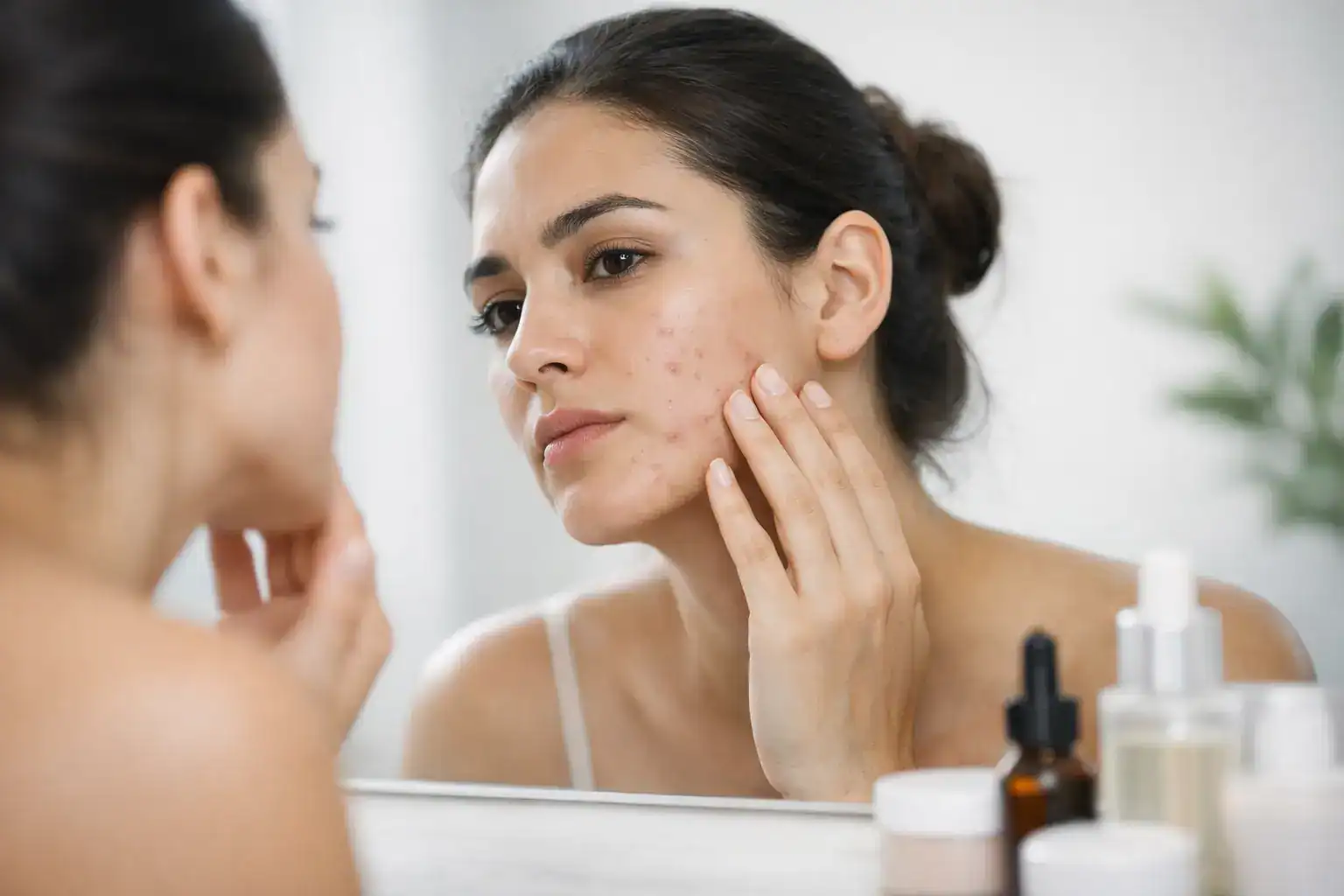
Choosing acne scar treatment for boxcar scars starts with understanding the depth of the depressions, your skin’s response to injury, and the improvement you want to achieve. A treatment that softens shallow scars may offer limited improvement for deeper, sharply defined indentations.
We recommend approaching treatment as a personalised decision rather than selecting a procedure because it is popular. A useful consultation should explain which scars can respond to resurfacing, which may need targeted correction, and how recovery fits into your daily routine.
Identify Boxcar Scars Before Choosing Treatment
Boxcar scars are round or oval depressions with clearly defined edges. They belong to a group called atrophic acne scars, which develop when inflammation damages the skin’s supporting tissue. Their appearance differs from narrow ice-pick scars and the sloping depressions associated with rolling scars.
Flat brown or red marks after acne are also different from depressed scars. Discolouration can occur alongside boxcar scars, but improving colour does not necessarily correct the indentation. We recommend asking your dermatologist to identify each concern separately so your treatment plan addresses both texture and pigmentation where necessary.
Details to Discuss During Your Scar Assessment
Before comparing procedures, establish the following:
- Scar depth: Are the depressions shallow, deep, or a mixture?
- Scar distribution: Are there a few isolated scars or widespread uneven texture?
- Mixed scarring: Are rolling or ice-pick scars present alongside boxcar scars?
- Skin response: Do you develop persistent dark marks or raised scars after injury?
- Treatment priorities: Is your main concern depth, sharp edges, overall texture, or colour?
These questions help turn a general request for smoother skin into specific treatment goals.
Compare Acne Scar Treatments by the Problem They Address
We recommend evaluating each option by its purpose. Resurfacing, collagen stimulation, lifting, and surgical correction address different features of depressed scars. The most appropriate choice depends on the individual scar rather than the treatment’s name.
Fractional Laser Resurfacing for Uneven Texture
Fractional laser resurfacing may help soften scar edges and improve surrounding texture. Ablative and non-ablative approaches differ in how they affect the skin, so the exact device and treatment settings matter.
Resurfacing is generally more useful for superficial scarring than for correcting a pronounced, deep depression on its own. Ask whether the proposed laser is intended to improve your entire skin surface or treat specific scars. An explanation of its limitations is as valuable as an explanation of its benefits.
Microneedling for Collagen Stimulation
Professional microneedling creates controlled punctures that stimulate collagen production. It can reduce the visibility of depressed acne scars and may form part of a broader treatment plan.
We recommend asking how progress will be assessed before committing to a series. Your dermatologist should explain whether microneedling alone is appropriate or whether another procedure would better address particular depressions.
Targeted Procedures for Prominent Depressions
For selected deep or prominent scars, a dermatologist may consider scar surgery, including techniques that remove or lift an individual depression. Fillers may also be considered when adding volume beneath a scar would help.
These approaches deserve discussion when your main concern is a small number of noticeable indentations. Ask what improvement is expected at each treated site and whether later resurfacing would help blend the area with surrounding skin.
TCA CROSS for Selected Boxcar Scars
TCA CROSS is a targeted chemical technique that uses trichloroacetic acid within individual scars. It may be suitable for selected boxcar scars, but suitability depends on scar characteristics and clinician experience.
Potential complications include irritation, pigmentation changes, and adjacent scars merging into a larger scar. Complete correction is unlikely with this technique alone. We recommend discussing the reason for choosing it, alternatives, and the clinician’s experience rather than treating it as a routine facial peel.
Choose a Dermatologist With Relevant Scar-Treatment Experience
The consultation should provide a clear diagnosis and an understandable plan. We recommend checking the practitioner’s specialist credentials, experience with acne scarring, and familiarity with your skin tone.
Before-and-after photographs can support the discussion, but they should show comparable scar patterns under consistent lighting. Ask whether the examples involved additional treatments and how long after treatment the photographs were taken.
Questions to Ask Before Booking
Bring a short list of practical questions:
- Which features of my boxcar scars will this procedure address?
- Why do you recommend it over the alternatives?
- What improvement would you consider realistic?
- What are the main risks for my skin?
- Who will perform the procedure?
- How will you manage an unexpected reaction?
- When will we review results before deciding on further treatment?
We recommend leaving the consultation with enough information to explain the plan in your own words. If the explanation remains unclear, request clarification before purchasing a package.
Consider Skin Tone and Pigmentation Risk
Post-inflammatory hyperpigmentation and keloid scarring are more common in skin of colour. Scar treatment can also cause unwanted colour changes, infection, or additional scarring.
We recommend discussing your history of dark marks, raised scars, and previous reactions to procedures. These details help your dermatologist assess treatment intensity and precautions. Ask how the plan accounts for your individual healing history rather than relying on broad claims that a procedure suits everyone. DermNet
Control Active Acne Before Treating Existing Scars
Ongoing breakouts can create new scars while you are treating older ones. Dermatologists therefore generally begin with acne control before proceeding with scar procedures.
Tell your dermatologist about current and previous acne treatments, including prescription medicines and topical products. This information can affect procedure timing and preparation. We recommend coordinating acne management and scar treatment within one plan so each supports the other.
Compare the Full Treatment Cost
The advertised price of one appointment does not necessarily represent the complete cost. We recommend requesting an itemised estimate before committing.
Expenses to Include in Your Comparison
Check whether the quotation covers:
- The initial consultation and assessment.
- Each planned procedure or treatment session.
- Anaesthesia, where applicable.
- Prescribed preparation and aftercare products.
- Follow-up appointments.
- Additional treatments proposed after reassessment.
Also consider transport, time away from work, and whether repeat visits are manageable. A useful plan should identify the first step, the review point, and the circumstances that might justify further spending.
Match Recovery Requirements to Your Schedule
Discuss recovery in practical terms. Ask when you can return to work, exercise, makeup, and your usual skincare routine. Clarify whether visible redness or crusting may affect public-facing responsibilities.
Aftercare commonly includes gentle cleansing, following procedure-specific instructions, and protecting treated skin from sunlight. The American Academy of Dermatology recommends broad-spectrum, water-resistant sunscreen with SPF 30 or higher. Your clinician should explain when products can be applied and which activities to avoid while healing.
Set Realistic Goals and Review Progress
We recommend defining success before treatment begins. You might prioritise softer scar edges, less noticeable shadows, or improved texture across the cheeks. Specific goals make it easier to assess whether treatment is worthwhile.
Collagen-related improvement takes time, and multiple treatments may be needed. Follow-up appointments allow your dermatologist to assess healing and decide whether to continue or adjust the approach.
Use consistent photographs and agreed review points rather than judging results from day-to-day mirror checks.
FAQs about How to Choose Acne Scar Treatment for Boxcar Scars
1. What is the best treatment for boxcar acne scars?
The best treatment depends on the depth, width, number, and location of the scars. Common options include fractional laser therapy, microneedling, chemical peels, subcision, dermabrasion, and certain injectable treatments. A dermatologist can recommend the most appropriate approach.
2. How do I choose the right acne scar treatment for boxcar scars?
Start with a professional skin assessment. Consider your skin type, scar severity, treatment goals, recovery time, budget, and risk of pigmentation changes before selecting a procedure.
3. Is microneedling effective for boxcar scars?
Microneedling may improve mild to moderate boxcar scars by stimulating collagen production. Deeper scars may require combination treatments for more noticeable improvement.
4. Are laser treatments suitable for boxcar acne scars?
Fractional laser treatments can help improve skin texture and reduce the appearance of certain boxcar scars. However, suitability varies depending on skin tone, scar depth, and medical history.
5. Can chemical peels remove boxcar scars?
Chemical peels may improve shallow boxcar scars and uneven skin texture, but deeper scars generally require more targeted procedures.
6. How many treatments are usually needed?
The number of sessions varies according to scar severity and treatment type. Most acne scar treatments require multiple sessions with gradual improvement.
7. Should I see a dermatologist before choosing treatment?
Yes. A qualified dermatologist can identify your scar type, assess your skin, explain potential risks, and create a personalised boxcar scar treatment plan designed for safer and more effective results.
Conclusion
The best way to choose acne scar treatment for boxcar scars is to match the procedure to the scar’s characteristics, your healing history, and your priorities. We recommend a specialist assessment, a clear explanation of alternatives, an itemised cost estimate, and realistic recovery expectations.
A well-considered plan gives you a defined starting point and a meaningful way to judge progress before committing to further treatment.