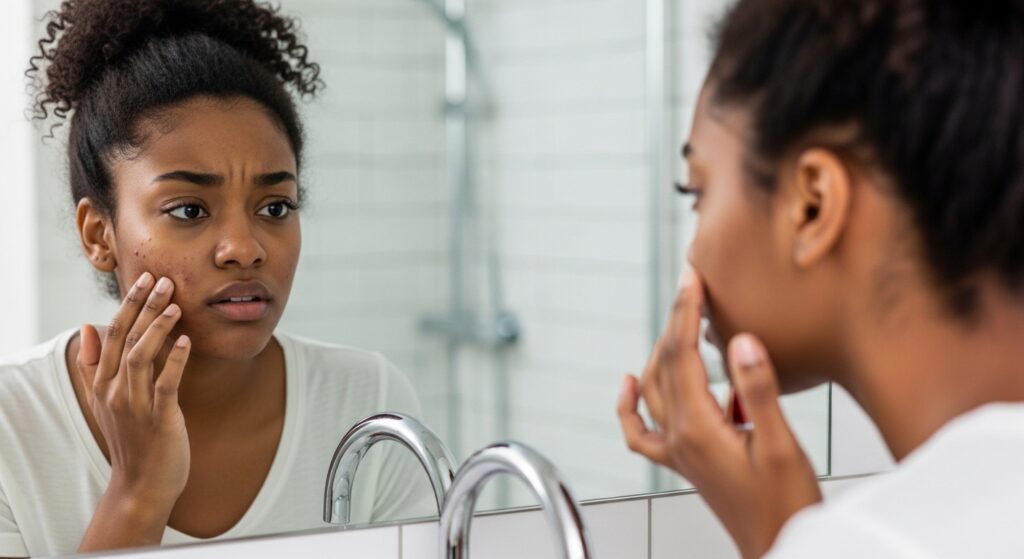
Choosing acne treatment for Black skin means considering active breakouts, lingering dark marks, and how well your skin tolerates treatment. A product that reduces pimples but causes persistent irritation can complicate the goal of achieving a clearer, more even complexion.
We recommend choosing treatment according to acne severity, skin sensitivity, and the presence of post-inflammatory hyperpigmentation. Black skin can be oily, dry, sensitive, or a combination of these. Skin colour alone does not determine which product will work best.
Understand Your Breakouts Before Choosing Treatment
Before buying an acne product, we should identify the main concern. Are there mostly clogged pores, inflamed pimples, deep painful bumps, or dark marks left after previous breakouts? These concerns may require different approaches.
A treatment plan should address existing acne while helping prevent future lesions. Treating only the visible marks leaves the underlying breakouts free to create additional discolouration. The American Academy of Dermatology recommends addressing acne and dark spots together, particularly in darker skin tones.
Common Acne Concerns to Assess
- Blackheads and whiteheads: Clogged pores that may respond to treatments designed to keep pores clear.
- Inflamed pimples: Raised, tender bumps that may require treatment targeting inflammation and acne-related bacteria.
- Deep, painful nodules: More severe lesions that warrant professional assessment.
- Flat dark marks: Discolouration following inflammation, which requires a different assessment from changes in skin texture.
We should also consider where breakouts occur, how often they return, and whether a previous treatment caused burning, dryness, or peeling. This information helps guide a more suitable choice.
Choose Acne Ingredients That Match Your Main Concern
The best acne treatment for Black skin is not necessarily the strongest formula or the most expensive product. We should prioritise ingredients supported by dermatology evidence, then consider their formulation, tolerability, and suitability for our circumstances.
Ingredients Commonly Used for Acne
Topical retinoids, including adapalene and prescription options such as tretinoin, help clear clogged pores. They can treat blackheads, whiteheads, and some inflammatory lesions. A dermatologist may also recommend a retinoid for maintenance once breakouts improve. Some retinoids can help fade post-acne dark marks, although irritation needs careful management.
Benzoyl peroxide reduces acne-related bacteria and is an established option for inflammatory acne. When choosing a product, we should consider both the concentration and the instructions rather than assuming a stronger preparation will deliver better results.
Salicylic acid helps unclog pores and may be useful when blackheads and whiteheads are prominent. However, adding it to an already intensive routine may increase irritation.
Azelaic acid is another option, particularly when acne occurs alongside uneven pigmentation. It can address acne and the dark spots that remain after lesions clear. Dermatology guidelines support these ingredients, with the strength of recommendations differing between treatments.
Protect Black Skin From Treatment-Related Irritation
We should assess how a treatment feels and how the skin responds, rather than judging effectiveness by peeling or stinging. A comfortable routine is easier to maintain consistently.
For darker skin tones, irritation deserves particular attention because it can trigger additional dark spots. Products marketed for acne or brightening may still be unsuitable if they repeatedly cause inflammation. Gentle, fragrance-free skincare can be helpful when sensitivity is a concern.
Questions to Ask Before Adding a Product
- Does it contain an ingredient already used elsewhere in the routine?
- Is it intended for daily use or less frequent application?
- Does the label warn against combining it with other treatments?
- Have similar products caused irritation previously?
- Can we follow its directions consistently?
Introducing several products at once makes it difficult to identify which one helps and which one causes problems. We should follow product instructions and seek advice if irritation persists.
Build a Simple Routine Around Acne Treatment
A manageable routine gives treatment a practical place in everyday skincare. We recommend selecting supporting products carefully instead of filling the routine with multiple exfoliants, masks, and spot treatments.
Supporting Skincare to Consider
- A gentle cleanser: Choose a product that cleans without leaving the skin uncomfortable.
- A suitable moisturiser: Look for a formulation compatible with acne-prone skin and personal sensitivity.
- Daily sunscreen: Choose broad-spectrum protection with SPF 30 or higher.
- Non-comedogenic products: These are formulated to be less likely to clog pores.
For people concerned about hyperpigmentation, a tinted sunscreen containing iron oxide can also help protect against visible light, which may worsen dark spots. A sunscreen that feels comfortable and suits the complexion is more likely to be used regularly.
Avoid Habits That Can Undermine Acne Treatment
Treatment choices extend beyond the medication itself. We should review skincare, grooming, and haircare habits that may contribute to breakouts or irritation.
Picking or squeezing lesions can increase the risk of lingering marks and scars. Oily hair products can also contribute to breakouts along the hairline and forehead. If acne clusters in these areas, reviewing products that contact the skin may be useful.
Practices to Reconsider
- Repeatedly squeezing or scratching pimples.
- Using abrasive scrubs on inflamed skin.
- Applying several drying treatments together.
- Continuing products that consistently sting or irritate.
- Using toothpaste as a spot treatment.
Toothpaste is not an acne medication. Its ingredients may irritate or damage the skin without treating the underlying acne. We should choose products formulated for acne rather than relying on household remedies.
Know When Prescription Acne Treatment Is Appropriate
We recommend seeking professional assessment for deep painful breakouts, developing scars, persistent acne, or significant emotional distress. A dermatologist can evaluate severity and decide whether topical treatment alone is sufficient.
Prescription options may include combination topical medicines, oral antibiotics, or hormonal treatment for suitable patients. Isotretinoin may be appropriate for severe acne, acne causing scarring or substantial psychological burden, or acne that has not responded to standard treatment.
These medicines require individual assessment. Guidelines also recommend limiting systemic antibiotic use and combining antibiotics with appropriate topical treatment to help manage resistance. pubmed.ncbi.nlm.nih.gov
Check Pregnancy and Other Health Considerations
We should disclose pregnancy, plans to become pregnant, breastfeeding, current medicines, and previous reactions before choosing treatment.
Pregnancy can change which acne medicines are appropriate. Oral isotretinoin must not be used during pregnancy, and topical retinoids are generally avoided. Azelaic acid may be considered, but treatment should be reviewed with an obstetrician or dermatologist. An over-the-counter label does not automatically establish suitability during pregnancy.
Choose a Dermatologist Experienced With Darker Skin Tones
When professional care is needed, we should look for experience treating acne and pigmentation concerns in darker skin. A useful consultation should cover previous treatments, sensitivity, scarring, daily skincare, and the outcome we want to achieve.
Questions for an Acne Consultation
- Which type of acne do we have?
- How will treatment address both breakouts and dark marks?
- What irritation should prompt a review?
- Which existing products should we continue?
- When should progress be assessed?
- What will ongoing treatment cost?
These questions help turn a prescription into a clear, manageable plan.
Allow Enough Time to Assess Results
Acne treatment requires consistent use. We should track changes in new breakouts, discomfort, and tolerability rather than expecting an immediate transformation.
The American Academy of Dermatology notes that effective treatment may produce fewer breakouts within four to eight weeks, while more substantial clearing can take longer. If results remain unsatisfactory, a dermatologist can reassess the approach. Persistent irritation or worsening painful acne deserves earlier review.
FAQs about How to Choose Acne Treatment for Black Skin
1. How do I choose the right acne treatment for Black skin?
Choose products that treat breakouts while minimizing irritation and post-inflammatory hyperpigmentation (PIH). Gentle, non-comedogenic skincare combined with proven acne ingredients is usually preferred.
2. Which acne ingredients are suitable for Black skin?
Common options include salicylic acid, benzoyl peroxide, adapalene, and azelaic acid. Azelaic acid can be particularly useful because it may help address both acne and the dark marks left after breakouts.
3. Why is hyperpigmentation important when treating acne on Black skin?
Darker skin tones may develop noticeable dark spots after acne inflammation. Aggressive treatments that cause irritation can worsen discoloration, so controlling inflammation while protecting the skin barrier is important.
4. Should I use strong acne products for faster results?
Not necessarily. Using high concentrations or several active ingredients at once may cause dryness, burning, peeling, and irritation, potentially making pigmentation concerns worse. Introduce treatments gradually.
5. Is sunscreen necessary for Black skin with acne?
Yes. A broad-spectrum SPF 30 or higher can help prevent acne-related dark marks from becoming darker and supports treatment of existing hyperpigmentation.
6. What should I look for in acne skincare products?
We recommend looking for products labelled non-comedogenic, gentle, and suitable for your skin type. Avoid unnecessarily harsh scrubs and products that repeatedly irritate your skin.
7. When should I see a dermatologist?
Consider professional care if you have painful cystic acne, persistent breakouts, scarring, significant hyperpigmentation, or acne that does not improve with appropriate over-the-counter treatment. A dermatologist can create a treatment plan suited to both your acne and skin tone.
Conclusion
To choose acne treatment for Black skin, we should match treatment to the type and severity of breakouts, account for dark marks, and protect the skin from unnecessary irritation. Evidence-based ingredients, supportive skincare, and consistent use provide a practical foundation.
When acne is painful, persistent, or causing scars, professional assessment helps identify a treatment plan suited to both the condition and the individual complexion.